
Up to 40% of the clothing produced each season ends up unsold or destroyed. The cause isn't bad math — it's a financial calculation built into global supply chains.
Every year, billions of brand-new garments are manufactured, shipped, and immediately incinerated or dumped into landfills without ever being worn. Industry insiders call this “Ghost Inventory” — the phantom supply generated by flawed forecasting systems.
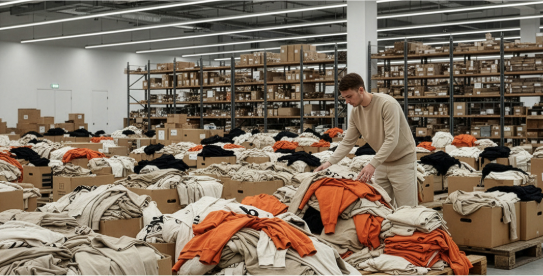
Fashion forecasting attempts to predict consumer tastes 6 to 12 months in advance using historical sales data, trend agencies, and predictive algorithms. Yet, despite increasingly sophisticated data models, up to 40% of all clothing produced each season ends up discarded, unsold, or destroyed.
The system fails not because brands don’t understand math, but because of a deliberate financial calculation built into global supply chains.
Apparel supply chains rely on manufacturing hubs halfway across the world. To secure factory time, fabric, and shipping, brands must finalize orders months before a single customer buys the product. In operations research, this is known as the Newsvendor Problem: deciding how many units to order when demand is uncertain and the product loses value rapidly at the end of the season.
Manufacturing costs drop drastically as volume increases. For a brand, producing 100,000 units of a trench coat might cost $10 per unit, while producing only 20,000 units raises the cost to $25 per unit.
Brands deliberately over-order because the financial penalty of stocking out (losing a full-margin sale) is far higher than the penalty of overproducing (cheap per-unit cost). Financially, overproduction is treated as an acceptable insurance policy against running out of stock.
Micro-trends driven by social media platforms decay far faster than traditional 6-month production cycles can handle. By the time a forecast-driven bulk order arrives at a distribution center, the trend cycle has often moved on, leaving retailers with thousands of unmarketable items.
The result is a structural conflict: forecasting models are optimized to maximize revenue security and minimize unit costs, rather than align with real-world ecological limits or actual consumer demand. Until fashion shifts toward real-time demand manufacturing and shorter supply chains, the math will continue to favor ghost inventory over sustainability.